
Avoid turning your mind into a spam factory.
We live in a world where people look more at screens than their eyes.
A world full of information that gives us a false sense of profound knowledge but, in truth, is superficial, fractal, and without context.
A multiverse of ideas, kitten videos, memes, and polarized opinions that compete voraciously for our attention.
We live in a reality where more has become less.
- The more information, the less informed we are.
- More data, less mental clarity.
- More points of view, less perspective.
- More criticism, less discernment.
All this that we live on reminds me of when my mother used to tell me, “Son, don’t use the calculator, or you will forget to multiply.” And although I still haven’t forgotten the multiplication table, I worry about having my brain subrogated to a computing device as powerful as a smartphone.
I think that although today it is companies that pay social networks to use algorithms to position their products, tomorrow we will be the ones paying to have algorithms recommending us specific content to achieve a goal: to lose weight, to learn a language, to be successful.
All this isn’t comforting and makes me practice reading and writing daily, so I don’t forget to think for myself.
But how to compete in an increasingly technological world?
The answer is to think better.
And how do you think better?
Well, by being more original. Because the value of new ideas is always a rising value.
But it is difficult to have genuine ideas when brains are flooded with 60-second videos and millions of notifications.
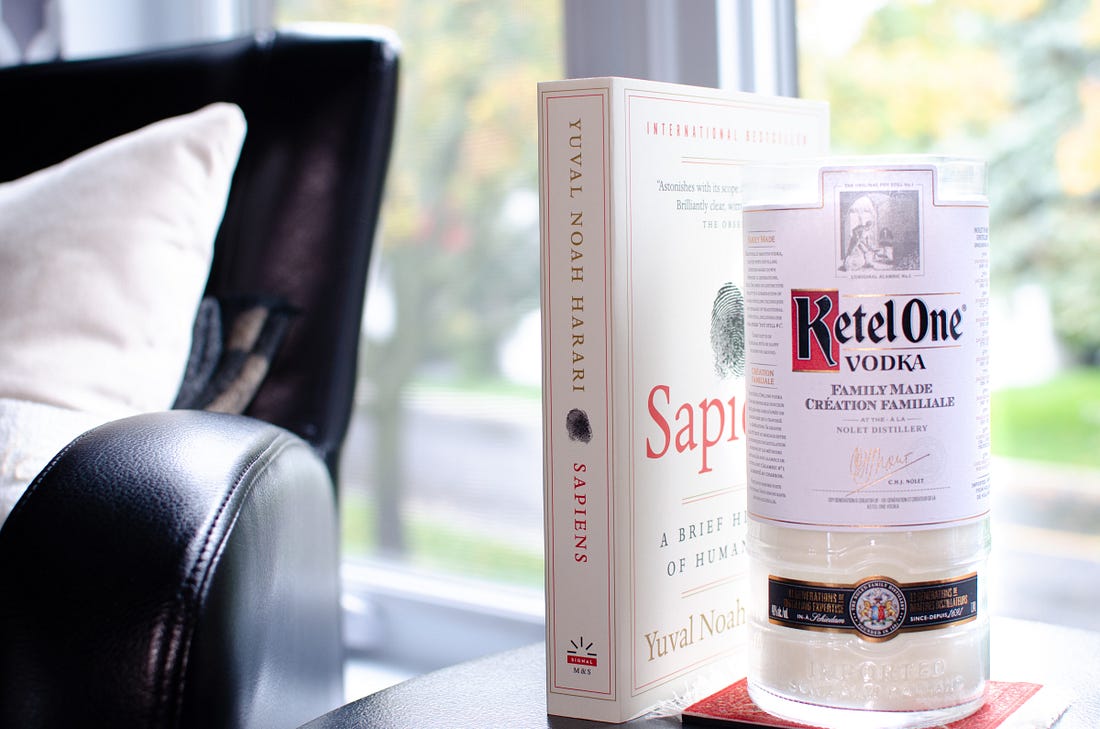
For this, I want to show you a method I discovered last week in an interview that Lex Fridman made with Yuval Noah Harari, in which the author of Sapiens explains his deep thinking process.
Let’s start
First step: train the mind to be silent and observe.
“Meditating is the most important thing I do as a writer and a scientist. I spend 2 hours every day in silent meditation, observing as much as possible, non-verbally, what is happening within myself, focusing, you know, body sensations, the breath.” — Yuval Noah Harari
Yuval confesses that he needs to meditate for two hours daily to distance himself from his cognitive biases and the stories he tells himself.
To see reality more clearly.
The author says, “Don’t engage with the words because the mind is always making stories with the words. These stories come between us and the world. They don’t allow us to see ourselves or the world.”
During the interview, Yuval recalls that when he first started meditating — 23 years ago — he would focus on his breath and could not go more than 10 seconds without getting caught up in a thought that would take his concentration away.
And it was then that he realized that it was necessary to improve his concentration to improve his thinking because he would come to ask himself, “If I can’t observe my breath because of these stories created by the mind, how can I hope to understand much more complex things?”
To do this, he practices the Vipassana meditation he learned from Master S.N. Goenka for two hours every day, and once a year, he goes on a silent meditation retreat for a couple of months.
Second step: have an “Information-diet.”
“Be very aware of what you feed your mind.”— Yuval Noah Harari
In the interview, Yuval acknowledges that he prefers reading books to reading tweets and doing three-hour interviews rather than five-minute meetings because it is possible to go much deeper into the topics covered.
The author insists that it is essential to go deeper and not to stay on the surface.
We must prioritize quality over quantity. — Don’t forget that social networks and mass media use your curiosity against you to market your attention to potential advertisers.
If you realize today’s access to so much information can paradoxically become a source of ignorance. Too much noise prevents us from hearing.
In the words of Walter Benjamin, “Saturated with information, we have lost the ability to understand.”
We do not give the mind time to process what is happening, and we move from one piece of news to another with the speed of a click, scrolling the screen, imitating the gesture of lowering the lever of the slot machines in Las Vegas casinos.
We consume unverified information that we file in our minds and build our opinions with those corrupted bricks of information. — We turn our head into a spam factory.
Because it’s one thing to surf the web for relevant information and another to surf a tsunami of memes, conspiracy theories, and trolls pouring their mental diarrhea into the networks.
That’s why learning to bend impatience is 50% of thinking outside the box; that’s why Yuval gives so much importance to the first step: meditation.
The other 50% is to give yourself enough time to 1) read valid and relevant information and 2) that what you were not looking for appears in the middle of what you are investigating and improves it, turning it into something new, a brilliant idea that seems to be the result of chance but that in the end is the result of constancy, neutral observation free of bias and therefore of causality.
And for the latter, it is necessary to deepen the information you consume and not stay in the increasingly superficial short-format information: tweets, 60-second videos, etc.
Third step: write and delete.
“The most important button on the keyboard is Delete.” — Yuval Noah Harari.
After meditating and nourishing himself with information by reading books, Yuval proposes to write.
As he says in the interview, “I read a lot without taking notes, and then I write like a torrent. Don’t stop, write.”
Yuval lets himself go; he doesn’t care about style or writing too crazy ideas. He confesses, “When I encounter a difficult intellectual problem, I let the problem lead me where it goes rather than where I wanted to go.”
And after writing, he edits ruthlessly, trying to locate his confirmation bias to remove them and create something new. An idea that is not based on his subjective way of seeing the world but is as neutral as possible so that he can bring real value to sharing it.
Recap for the memory
You must recover your attention, educate yourself through meditation, and don’t stay hooked to your flow of ideas. — Remember that today there is no more the problem of blank paper, but the problem of purging the excess of information to be able to think and write without noise.
You have to read long and quality content because otherwise, the algorithm in your head will only connect Youtube tutorials with motivational tweets.
You have to dump your ideas on the paper because writing is another way of thinking: a more structured one. Write like a torrent, then edit and mercilessly delete those ideas you see resulting from your confirmation biases.
Following this simple process will give your thought depth and precision when communicated.
A virtual hug
AG
Leave a Reply